
Virtual Tour
State House
Featured Areas
Points of Interest
- A. State House Tours
- B. State Auditor
- C. State Treasurer
- D. Hearing Room 222
- E. Senate Counsel
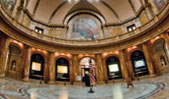
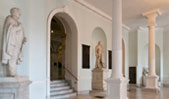

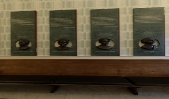
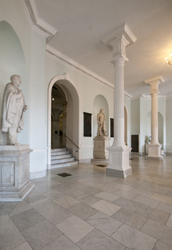
Opened upon the inauguration of the State House in January 1798, Doric Hall was designed by Charles Bulfinch, architect of the State House, to serve as the main public reception area in the new capitol. Ten Doric columns distinguish the fifty-five square foot room that overlooks Beacon Street from under the gold dome. This has been the setting for some of the most historic events to take place at the State House, including presidential visits, the issuing of flags to Massachusetts troops heading off to war, and wakes for the highest public servants. By tradition, the famous center doors are opened on three occasions: the visit of a head of state or high-ranking foreign dignitary, the return of military colors for decoration or investment into the State House Battle Flag Collection, or the departure of governors at the end of their terms, when the ""long walk"" is taken from the executive office out of the building. The hall is still a central gathering place for visitors and marks the first stop on a tour of the historic State House.
Doric Hall is decorated with a wide range of artwork and memorials to those who have made lasting contributions to the Commonwealth and nation. Two- and three-dimensional sculptures, paintings, and historical artifacts are installed throughout the room.
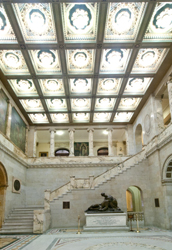
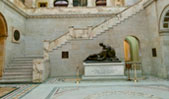
Nurses Hall was originally called Senate Staircase Hall as it contains one of two grand stairways to the legislative chambers on the third floor. The second Grand Staircase, located in the center of the Brigham Extension, leads to the entrance to the Chamber of the House of Representatives. The room slowly began to be identified as Nurses Hall after the installation of the imposing Civil War Army Nurses Memorial in 1914, until the name was officially changed by an act of the legislature in 1985.
The two-story hall is constructed of seven different kinds of Italian marble, and has an elaborately coffered gilded bronze ceiling and walls decorated with murals illustrating well-known events from the Revolutionary War era. The rich play of color and materials provides an elegant backdrop for the many bronze plaques and bas reliefs that commemorate both military and citizen service. In addition to providing a public gathering space in the Brigham extension, this hall prepares one for the solemnity and grandeur of the adjacent Memorial Hall.
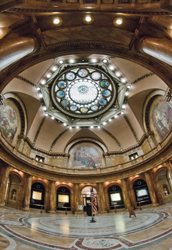
Opened January 1, 1900, Memorial Hall was created to pay tribute to Massachusetts veterans of the Civil War. The circular room is constructed of Italian Sienna marble, with an intricate mosaic floor and semi-circular niches that for many years held the torn and tattered battle flags from this and later conflicts. Reproductions from the State House Flag Collection now appear on the glass-front cases to remind viewers of the extraordinary service and sacrifice of its citizens. Murals illustrating significant events in Massachusetts history adorn the gallery, and the whole is capped by a magnificent stained glass window displaying the seals of the thirteen original colonies. This hall is reserved for veteran's services and other solemn occasions.
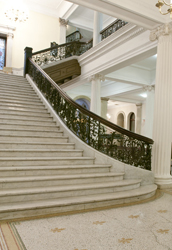
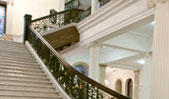
One of two staircases within the late-nineteenth century addition, the Grand Staircase provides access from the ceremonial halls of the second floor to the representatives' chambers on the third. Wrought iron rails are of an original pattern called ""Black Lace,"" designed by John Williams Company of New York. On the landing of the split stairs is a Palladian stained glass window containing the earliest seals of Massachusetts as well as those of the royal governors. Frank Hill Smith painted the coved ceiling with the names of four colonial patriots (Samuel Adams, John Hancock, James Otis, and Joseph Warren) surrounded by allegorical symbols and references to Massachusetts; this is capped with a plaid-patterned laylight. The Grand Staircase is frequently used for meetings, performances, and other public gatherings.
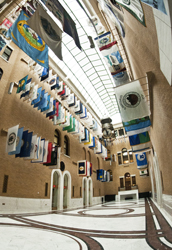
Great Hall was constructed in 1990 within the original open-air light well of the nineteenth century extension to provide additional meeting and event space for the State House. Designed by Shepley, Bulfinch, Richardson and Abbott, the original walls and windows were retained, and the new room capped by a sixty foot-long skylight in order to continue to bring light to the interior offices and hallways. Geometric floor patterns seen throughout the Brigham addition are echoed in Italian marble with a contemporary design and simplified color scheme. Below, two floors of hearing rooms were added to accommodate legislative committee business.
Great Hall is installed with a colorful display of flags from nearly every one of the 351 cities and towns in the Commonwealth. Most flags measure four by six feet and are constructed of either nylon or cotton muslin. Many feature the official coat of arms of their municipalities, while others are decorated with charming illustrations of recognizable landscapes or architectural landmarks, or with historical or symbolic references to elements that set their towns or cities apart from others. Notable among the flags are those that were designed by local civic groups specifically for this project and handcrafted by gifted artists, quilters, and seamstresses.
The flags are arranged chronologically according to the date of incorporation (the last being in 1851), and citizens delight in finding the flag of their home town in the display and noting which towns date to the same period as theirs.

By Thomas Ball, 1870
Marble, 80 x 37 1/2 x 19 in.
Gift of the citizens of Massachusetts under Res. 1868, ch. 37.
Dedicated February 14, 1871.
On graduating from Bowdoin College John Andrew entered into law and worked diligently in behalf of those in need of legal assistance, whatever their crime or economic means. After the arrest of escaped slave John Brown in 1859, he challenged the courts and raised funds for Brown's defense. A powerful, highly effective public speaker, Andrew quickly became a forerunner in state politics and was elected to office on the same ticket as Lincoln, with whom he became closely allied.
Andrew's entire administration was consumed by affairs of the Civil War. Even before his inauguration, Senators Charles Sumner and John Quincy Adams sent warnings to the governor-elect of imminent crisis, whereupon he moved quickly to obtain funding and ready the State militia, and personally issued arms and regimental colors to the troops as they were called into service.
A tireless exponent of the rights of the black man and preservation of the Union, following the Emancipation Proclamation of January 1863, Andrew organized the 54th, the first black regiment raised in the north, which was honored in the Robert Gould Shaw Memorial (1897), by Augustus Saint-Gaudens, opposite the State House.
Andrew died shortly after the close of the war, and a commemorative statue was authorized within the year. Thomas Ball modeled the statue in Boston and carved it in Florence where he maintained a large and active studio from 1865–1897. It occupies a place of honor in Doric Hall beside that of George Washington, which the artist recalled admiring as a child. These remain the only two full-length marble monuments at the State House. Andrew is also represented by a portrait in the gallery of governors.
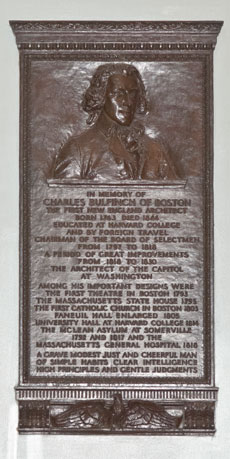
By Herbert Adams, 1899
Bronze, 61 x 28 1/2 x 2 3/4 in.
Commissioned by the Commonwealth, installed December 13, 1899.
In 1785 the General Court began considering plans to construct a new state house for the Commonwealth. Charles Bulfinch, aged 24, home from study in London in 1787, submitted his design for a building before the location for the new capitol had even been finalized. When land at the top of Beacon Hill was acquired from the estate of John Hancock, his plan was accepted. By the time construction began in 1795, Bulfinch was a seasoned architect, having designed the Connecticut State House as well as numerous other buildings.
High above Boston, with its gold dome, the capitol, completed in 1798, could be seen from any vantage point. At the inauguration, it was declared to be "the most magnificent building in the Union" and quickly become a symbol of the new republic.
Bulfinch would go on to design dozens of civic, academic and religious buildings as well as private residences, many of them on Beacon Hill. Through this body of work he imposed a federal style on the city, effectively changing the architectural landscape. He was eventually appointed Architect of the Capitol in Washington, D.C. in 1817, and was given charge of completing the construction of the capitol building.
This plaque was commissioned in 1898 to honor the architect on the capitol's 100th anniversary and his lengthy service as America's first native-born professional architect. A low-relief portrait of Bulfinch is adapted from a portrait painted by Mather Brown. A companion plaque is also installed in Doric Hall to commemorate the renovations undertaken to preserve the landmark building during the same year.
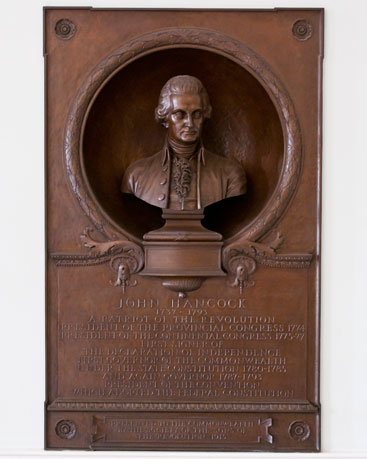
Cast by the J. N. O. William Inc., Bronze Foundry, New York, 1915
Bronze, 80 1/2 x 50 1/2 in.
Gift of the Massachusetts Chapter, Sons of the Revolution, under Res. 1913, ch. 7.
Dedicated October 19, 1915.
Despite the larger-than-life role John Hancock played in the history of Boston, the Commonwealth and the nation, the bronze memorial in Doric Hall was the first tribute to the merchant, Revolutionary War patriot and governor. The portrait head, cast from a larger marble statue by Horatio Stone (1858) at the U. S. Capitol, is set inside a Renaissance-style recessed plaque inscribed with but a few of Hancock's many contributions. Hancock is also represented by a portrait in the gallery of governors (1893), and a mural in the House Chamber celebrating his proposal of the Bill of Rights to the Federal Constitution (1942).
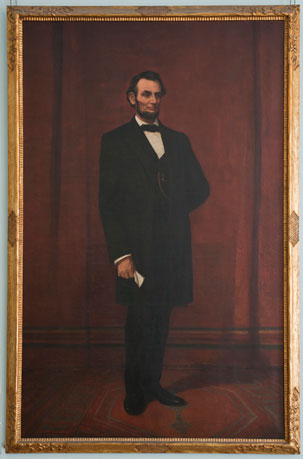
By Albion H. Bicknell, 1905
Oil on canvas, 96 x 59 in.
Purchased from the artist under Res. 1906, ch. 30 and Acts, 1906, ch. 307.
Unveiled October 23, 1906.
Abraham Lincoln ascended to the presidency campaigning in part against the institution of slavery and its spread among the new states. Upon his election, and the secession of seven of the southern states, Lincoln pledged to fight to preserve the Union, even if it meant plunging the country into a civil war. At the outbreak of hostilities, he drew upon his full authority as president, raising a Union army, imposing martial law, and suspending writs of habeas corpus in threatened areas of the Union. In 1863 he issued the Emancipation Proclamation, which freed slaves in those states still under Confederate control. The war ended April 9, 1865. Five days later, the President was assassinated.
In addition to the marble bust acquired in 1867 (installed in the Senate Chamber), an oil portrait of Lincoln was also proposed for the State House. Nearing the anniversary of Lincoln's 100th birthday, a portrait was finally authorized for purchase, and Albion Harris Bicknell of Malden, who had been painting the president since the war, was chosen. His full-length likeness, probably from photographs taken by Matthew Brady, was considered at the time to be his finest rendition. It was installed in the foyer of the Executive Suite until moved to Doric Hall in 1939.
Lincoln is also recognized in Doric Hall for his historic speech at the dedication of the National Cemetery at Gettysburg on November 19, 1863. A combination bronze plaque and portrait head reproduces the entire text of the Gettysburg Address. The portrait head was cast from a life mask taken by Leonard Volk in 1860 (now at the Smithsonian Institution) which Volk later patented and sold as replicas. The memorial was the gift of the Massachusetts Department of the Woman's Relief Corps, an auxiliary to the Grand Army of the Republic, in 1912.
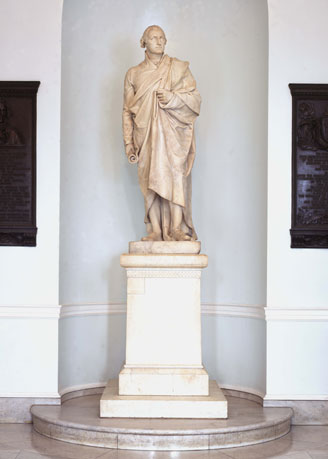
By Sir Francis Chantrey, 1826
Marble, 88 x 26 x 34 in.
Given by the Washington Monument Association under Res. 1799, ch. 66.
Dedicated November 26, 1827. Accepted under Res. 1828, ch. 35.
The death of the country's first president prompted an outpouring of grief, followed quite naturally by proposals of memorials across the country. In Massachusetts, the Washington Monument Association, incorporated in 1811, decided on a figurative memorial. As there were no accomplished sculptors in America, however, they secured the services of Francis Chantrey, of London, in 1818 to provide a "pedestrian [standing] statue of George Washington in white marble."
Chantrey applied his own formula—a calm, reflective pose and distant gaze—that had proved so successful in his other statues of statesmen. Washington is depicted as a representative of the people, rather than in military dress. Having never met his subject, the sculptor was loaned a full-length portrait of the president by Gilbert Stuart from which to model the face. The scroll and drapery held to the chest, however, are neo-classical references that were still popular in England. Unveiled in Doric Hall in November, 1827, the Washington was the first full-sized marble statue in New England.
Flanking the statue are facsimiles of the tombstones of Lawrence and Robert Washington, father and uncle, respectively, of John Washington (d. 1677), English immigrant to Virginia and great-grandfather of the president. They were taken from the original tombstones in the parish church of Brington, and presented to the Commonwealth by Earl Spencer through Charles Sumner in 1861.
Also in Doric Hall are small portraits of two important figures from the Revolutionary War era: the outspoken General Artemas Ward (b. 1727 – d. 1800), who was named general and commander-in-chief of the colony's militia by the Committee of Safety until he was appointed major-general by the Continental Congress in 1776, where he served as second-in-command under Washington.
Ward faces the portrait of his counterpart, Sir Thomas Gage (b. 1719 – d. 1787) who, from 1763 to 1777, served as commander-in-chief of the British forces in North America. Gage was briefly appointed military governor of Massachusetts in 1774.
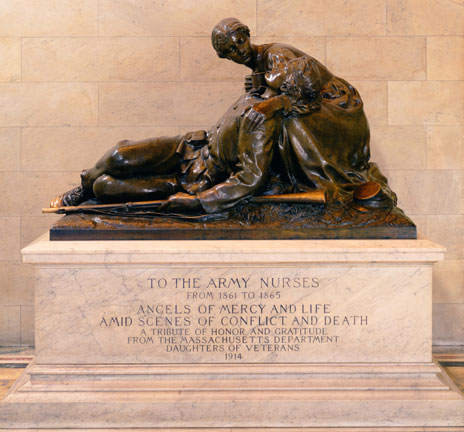
By Bela Lyon Pratt, 1911
Bronze, 52 x 88 1/2 x 47 in.
Given by the Army Nurses Memorial Association of the Massachusetts, Department Daughters of Veterans under Res. 1911, ch. 21.
Unveiled February 12, 1914.
It is impossible to know how many women volunteered their services during the Civil War. With loved ones enlisted and battle often at their doorstep, women looked for opportunities to assist at all levels. Although banned from the battlefield, they helped to ease suffering and speed recuperation in countless other ways. Many were recruited through the Army Medical Bureau, or the U. S. Sanitary Commission, which was responsible for monitoring camp and hospital conditions and distributing meals and supplies. Others ministered individually, as needed or as resources allowed.
Bela Pratt has based the sculpture on the Pietà, the familiar image of caregiver, cradling her charge on her arm and ministering with her free hand, which had been interpreted a few years earlier by Theo Alice Ruggles Kitson in the Mother Bickerdyke Memorial (1906), another Civil War nurses memorial in Galesburg, IL. In a sculptural style perfectly suited for the project, heavy, volumetric forms naturally give weight to the nurse, on whose physical and moral strength the wounded soldier depends. She supports his bulk easily. Her attempts to alleviate his suffering are tenderly and patiently rendered, her expression is both compassionate and businesslike. The symbolic grouping remains valid: it was incorporated by Glenna Goodacre into the Vietnam Army Nurses Memorial (1993) in Washington, D.C.
The commanding presence of this memorial has made it a landmark in its own right, and now it lends its name to the room in which it is placed. Staircase Hall became Nurses Hall in 1984 by an act of the legislature.
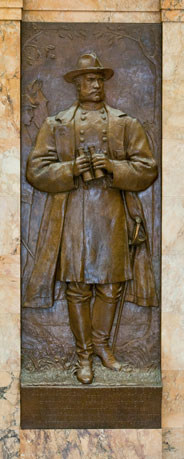
By Bela Lyon Pratt, 1905
Bronze, 96 x 33 x 3 in.
Given by the Stevenson Memorial Associations and friends under Res. 1905, ch. 20.
Dedicated December 7, 1905.
Stevenson, a member of the New England Guards, a militia company in Boston, was promoted to major and assigned to Fort Independence until the battalion was formed into the 24th Volunteers, and he was appointed the first colonel in 1861. After several prominent commands, including service at Fort Wagner, SC, in July 1863, he was noted for exceptional bravery, and placed in command of the First Division of the Ninth Corps. In May 1864, after fierce engagement at the Battle of the Wilderness, he moved with General Hancock to Spotsylvania. There, he established his lines close to the Confederates and was killed on the Fredericksburg Road.
Bela Pratt studied at Yale, with Augustus Saint Gaudens at the Art Students League, New York, and at the Ecole des Beaux Arts, Paris; for many years he taught at the School of the Museum of Fine Arts, Boston. His works ranged from medals and portrait busts to bas-reliefs and major public monuments, such as the Civil War Army Nurses Memorial, also in Nurses Hall, which drew on his refined technique, naturalism, and restrained sentiment.
Although he died in battle at age twenty-eight, Stevenson is depicted in this memorial as an assured but older man, perhaps as a way of communicating his experience and leadership. Here, he has dismounted from his horse and stands with his field glasses in hand ready to survey the lines. Pratt's skillful modeling of the bronze communicates the detailed scene in a relief less than four inches deep.
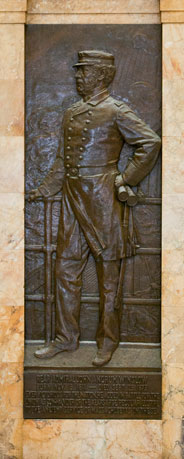
By William Couper, 1909
Bronze, 96 x 33 3/4 x 3 in.
Commissioned under Res. 1908, ch. 63 and Acts 1908, ch. 538.
Unveiled May 8, 1909.
Descendant of a brother of Governor Edward Winslow, and Mayflower passenger Mary Chilton, John Winslow entered the U. S. Navy in 1827, and after service during the Mexican War was promoted to commander in 1855. Although born in the South, Winslow, with his New England heritage and strong anti-slavery sentiments, joined the Union navy, and was assigned to the Western River Squadron.
In 1863 he took command of the Kearsarge, then in the Azores, and patrolled the continental coast in search of Confederate ships sailing to Europe for repairs. Through intelligence, he learned of the docking of the notorious Alabama, "a most troublesome enemy," at Cherbourg. Upon her re-launching, Winslow sailed to neutral territory and engaged the Confederate ship June 19, 1864, sinking her and taking seventy prisoners. He and his crew were hailed throughout the United States and in Congress upon their return; Winslow was promoted to commodore effective the date of the battle. He retired a rear-admiral in 1870 after commanding the Pacific Fleet.
Winslow is picture on the deck of the Kearsarge looking out to sea. Couper has followed the format of the companion relief of Thomas G. Stevenson by Bela Pratt, at its side, with a lively naturalism. After attending Cooper Union, the sculptor had spent two decades in Florence, Italy studying and working with local and American sculptors, notably Daniel Chester French (Joseph Hooker, Thomas Bartlett) and Thomas Ball (John Andrew), whose studio he joined until his return to New York in 1897.
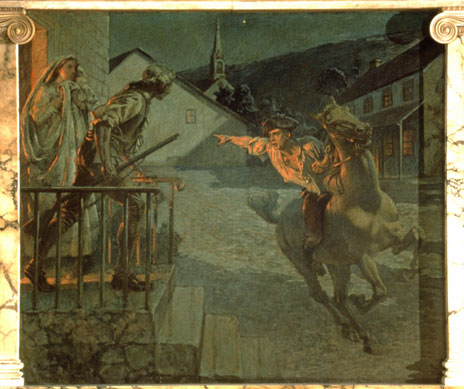
By Robert Reid, assisted by Edward Trumbull, 1904
Oil on canvas, 118 x 134 in.
Commissioned by the Commonwealth under Acts 1900, ch. 362.
Unveiled December 5, 1904.
Paul Revere's midnight journey on the eve of the Revolution is the most famous of the many rides he made throughout the colonies as official courier for the Provincial Assembly to Congress. Prior to April 18, Boston and the surrounding countryside were teeming with intelligence-gathering British and colonials alike. With increased activity in Boston Harbor on April 16, General Thomas Gage's plans to march on Lexington and Concord were anticipated, and Revere was sent to alert John Hancock and Samuel Adams, who, as enemies of the crown, were sequestered in Lexington.
Two nights later, upon the crossing of the British into Cambridge, messengers were again dispatched to Lexington: Revere by way of Arlington and Medford, and William Dawes through Roxbury and Cambridge. The pre-arranged warning by lantern in the steeple of Christ (Old North) Church signaled other riders to spread the word that the British army was on the march. After delivering their message, Revere and Dawes, joined by Samuel Prescott, proceeded to Concord. Revere was captured and interrogated, but in the mounting confusion of the morning allowed to go free. On his way back to Lexington Green he witnessed the arrival of the British troops, and heard the first shots fired in the War for Independence.
Revere, an ardent patriot and successful businessman, offered his talents as an engraver, printer, and metal smith to activities from unloading tea in Boston Harbor and producing patriotic broadsides like the Boston Massacre to designing the first continental currency and coppering the dome of the new State House on Beacon Hill. He was a member of the Committee of Correspondence and worked to gain support for the federal constitution. Revere died at the age of eighty-three; his house still stands on Revere Street in the North End, Boston.
Robert Reid has pictured Revere riding through one of the many towns between Boston and Lexington, waking the residents and calling en route. A minuteman leaves his house, responding to the call. Firelight escapes the open door, illuminating the figures. Reid, a painter better known for a light impressionist style, has drawn on his academic training in Boston, New York, and Paris to reproduce the drama of this historic night scene.
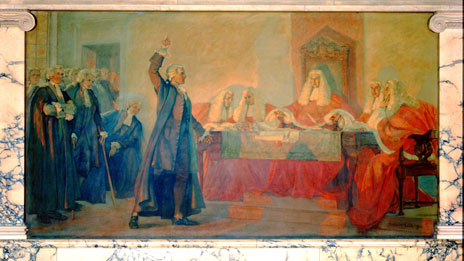
By Robert Reid, 1901
Oil on canvas, 118 x 213 in.
Commissioned by the Commonwealth under Acts 1900, ch. 362.
Unveiled January 1, 1902.
In this mural, James Otis confronts Chief Justice Thomas Hutchinson and four other judges in the Council Chamber of the Town House on the legality of the Writs of Assistance, warrants that permitted the arbitrary search and seizure of colonial property by agents of the king. According to the eyewitness account of John Adams, "Otis was a flame of fire!... American Independence was then and there born." Indeed, the argument was to lay the basis for Article Fourteen of the Declaration of Rights of the Massachusetts Constitution and led ultimately to the adoption of the fourth Amendment to the U. S. Constitution.
Reid drew inspiration from Adams' animated account of the trial, highlighting the drama with the fiery glow from the hearth just out of view, the captivated crowd in the doorway, the level gaze of the Chief Justice in his immense chair, and above all the defiant posture of the central figure. The frieze-like group stretches before us, drawing us into the scene. Reid's debt to earlier murals, especially those by John Singer Sargent at the Boston Public Library, is clear. Although well known for his impressionistic figural and landscape compositions, as a muralist he completed walls for the World's Columbian Exposition (1893) and the Library of Congress (1896) before receiving the State House commission.
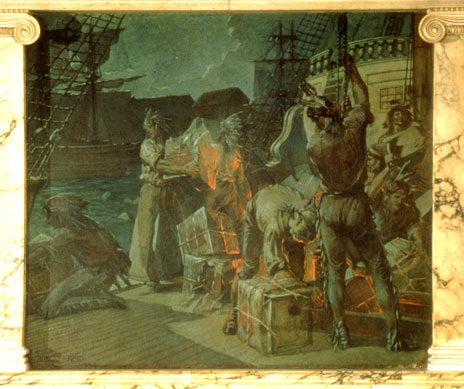
By Robert Reid, assisted by Edward Trumbull, 1904
Oil on canvas, 118 x 134 in.
Commissioned by the Commonwealth under Acts 1900, ch. 362.
Unveiled December 3, 1904.
The Boston Tea Party is sometimes called the first deliberate act of colonial resistance to British authority. At issue was the predisposition of the crown to pass laws and levy taxes without the consent of the colonists. After the repeal of the Townsend Acts in March 1770, the colonies were freed from duty on all commodities except tea. To counteract smuggling and help move burgeoning supplies, the 1773 Tea Act was enacted. Despite the low price, even with the duty, the rift over the Parliament's right to tax, and ultimately its right to govern the colonies directly, grew.
On December 16, 1773, three vessels of the East India Tea Company, who had been waiting for twenty days to unload, were barred from returning to Britain by customs officials, despite repeated requests for repeal of the taxes. Approximately 116 men, encouraged by Samuel Adams, John Hancock, Joseph Warren and Paul Revere, some disguised as Mohawk Indians, boarded the ships and quietly and efficiently spilled 342 casks, or 45 tons, of tea into Boston Harbor. They met no resistance.
Parliament was swift to act, however, and passed the Intolerable Acts and closed the Port of Boston. This cut the city off from all commerce, and systems of government and justice were altered, with any remaining liberties stripped away. Rather than isolating the colonies, however, news spread, enraging the citizens of other east coast cities who could see themselves as victims of such measures. In response, the First Continental Congress was created.
Robert Reid was commissioned to paint The Boston Tea Party, and its companion mural, Paul Revere's Ride, three years after completing the James Otis for Nurses Hall. The unidentified players are caught on the deck of one of the three ships that fell prey to the Sons of Liberty during their historic act. In the background can be seen warehouses at the harbor. The choice of these events may be explained in part by their value as night scenes, which allowed the artist to carry the firelight motif introduced in the earlier scene through the series.
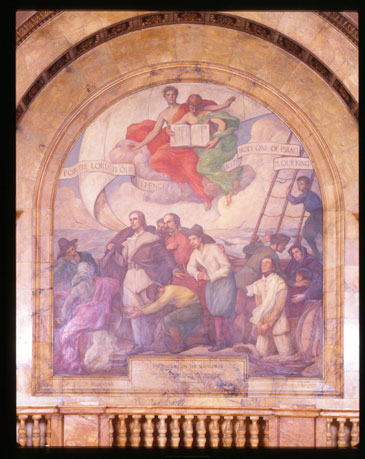
By Henry Oliver Walker, 1902
Oil on canvas, 175 x 162 in.
Unveiled May 29, 1902.
On September 6, 1620, 132 passengers and 30 crew departed from Plymouth, England on the Mayflower for the New World. Among them were a small group of Separatists, or Pilgrims, who had rejected the state church and "divine rule" of King James I, and were seeking a place where they "could live more comfortably, yet still enjoy freedom of religion." Others taking the journey included Miles Standish and John Alden, recruited to sail as part of the newly organized Council for New England, who continued to support the Church of England.
Storms tore at the vessel, ice-cold water leaked continuously into the crowded deck, and, at one point, the Mayflower threatened to break in two. One man died on the journey; one baby was born. "After a long beating at sea, they fell with that land which is called Cape Cod... they were not a little joyful." (Of Plymouth Plantation)
Walker's mural depicts the weary voyagers as they catch their first glimpse of the New World. The likeness of only one person, Edward Winslow, is known; the other passengers are the artist's invention. Above their heads, occupying half the canvas, hover two angels floating a banner which reads: "For the Lord is our Defence [sic], and the Holy One of Israel our King," (Book of Psalms 89:18), a reference to their relationship to God as the source of their strength and safety.
Although the Mayflower landed considerably farther north than its destination of northern Virginia, Captain Christopher Jones dropped anchor in Provincetown Harbor. With no patent to govern their party in New England, forty-one passengers signed the Mayflower Compact, the sole authority by which they would maintain law and order until a new patent arrived the following year. After exploring the outer cape and bay, the Pilgrims eventually settled at Plymouth. December 22 was named Forefathers Day, in honor of the first permanent landing.
The mural is painted with monumentality and breadth which attempts to communicate the climactic importance of the event and the heroic quality of its characters. The marble plaque below the frame is inscribed: "God sifted a whole nation that He might send choice green over into this wilderness," a quote from Governor William Stoughton, 1688.
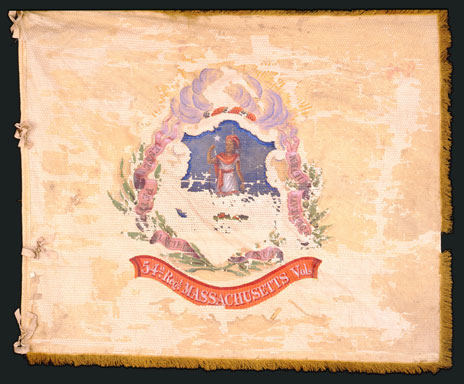
By Charles Eaton, 1863
Silk, pigment, 4 ft. 3 in. x 5 ft.
Issued by the Commonwealth April 28, 1863.
Returned to the Commonwealth March 31, 1875.
Massachusetts infantry units in the Civil War customarily carried both a national color and a white state color bearing the coat-of-arms. Several sets of colors could be issued to a regiment as its originals were damaged, destroyed, or lost in battle. This is the state color of the Massachusetts 54th—the first black regiment to be raised in the North. It was captured at the desperate assault on Battery Wagner, Charleston, SC, July 18, 1863, and was returned to the Commonwealth in 1875.
This flag is the companion to the national color saved by Sgt. William Carney at the same battle. Three-times wounded, Carney managed to bring the U. S. color back to the Union lines while uttering that most memorable phrase, "the Old Flag never touched the ground, boys!"—for which he was awarded the Medal of Honor by Congress.
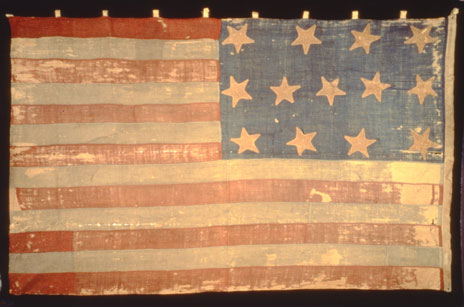
By unknown maker, 1781
Muslin, approx. 6 x 9 ft.
Given by George Fowle, grandson of Jonathan Fowle, 1906.
This thirteen-star flag was fabricated in 1781 for Jonathan Fowle, of Jamaica Plain, and is the oldest flag in the Massachusetts collection. It was made just after Congress adopted the "stars and stripes" design for the national banner.
The pattern for the stars in the canton, however, would not be standardized for many years. An orderly pattern of stars was sewn on the reverse whereas on the front they appear much smaller and irregular. When the flag was conserved in the 1920s the more handsome side was preserved, which is why it appears to be displayed "backwards," with the stars in the upper right. Upon its donation to the Commonwealth in 1906, Fowle's grandson George stated that this flag was flown at Fort Independence (Castle William) in Boston Harbor during the time his father was posted there as a member of the Boston Rangers.
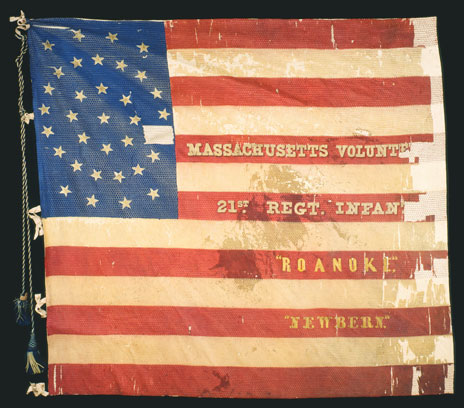
By unknown maker, 1861
Silk, pigment, 67 x 74 in.
Presented to the regiment by ladies of Worcester August 23, 1861.
Returned by the regiment to the Commonwealth January 28, 1863.
The position of color bearer during the Civil War was undoubtedly one of the proudest as well as one of the most dangerous a soldier could hold. The flags, always posted at the front, served as a beacon for one's fellow soldiers and the enemy alike. To "preserve the Union"—to never let it fall to the ground—was the gravest of responsibilities; one for which many color bearers gave their lives.
During the Battle of Fredericksburg, VA, at least five men in turn bore this national color before being wounded. One, Sgt. Thomas Plunkett, upon receiving the flag, moved to the front rank where it is recorded: "A shell was thrown with fatal accuracy at the colors, which brought them to the ground wet with the lifeblood of the brave Plunkett, both of whose arms were carried away." Amazingly, Plunkett grasped the flag with his upper arms to keep it from falling, pressing on before being relieved. The flag also bears the blood of Sgt. Peter Bryan, who, positioned beside one of the color-bearers, fell, mortally wounded in the head, on to the center of the flag.
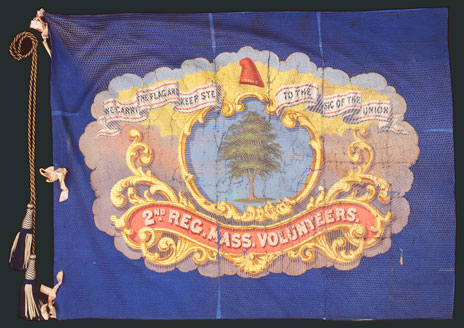
By unknown maker, 1861
Silk, pigment, 39 x 51 in.
Gift of friends and relatives of Rufus Choate to the regiment July 1, 1861.
Returned by the regiment to the Commonwealth December, 22, 1865.
Two of the flags of the Second Regiment were gifts to the unit. 2nd Lt. Rufus Choate was the son of a prominent Boston lawyer and statesman. The front side, which was obscured during an early conservation effort, shows the Massachusetts coat of arms. The reverse, seen here, depicts the pine tree side of the coat of arms. It bears the name of the regiment and the motto, "We carry the flag and keep step to the music of the Union."
Flags other than those issued by the state were often fabricated of colors different from the official design (which in this case would have been white), and were called "presentation" flags. Because of the strong local connections they symbolized, these flags were often carried in addition to the official national and state colors. The 2nd Irish, also in this display, is another fine example of a presentation color.
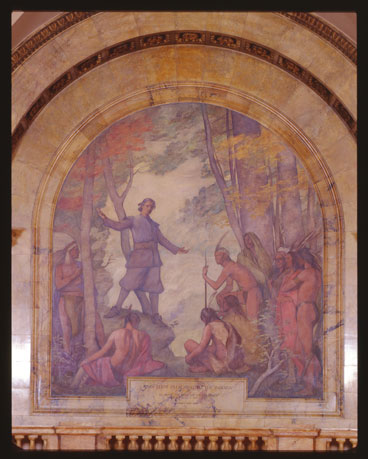
By Henry Oliver Walker, 1903
Oil on canvas, 175 x 162 in.
Unveiled April 8, 1903.
John Eliot (b. Hertfordshire, England, 1604 – d. Boston, 1690) immigrated to Boston in 1631 and was pastor of the Puritan Church in Roxbury for nearly sixty years. One of the first missionaries to the Indians, Eliot began preaching the Gospel to local Native Americans at Nonantum in 1646. Although his first sermons were in English, he soon mastered Algonquin for his preaching; the first Bible printed in North America in 1661–63 was his translation into the Indian language. In 1651 Eliot petitioned the General Court for a tract of land in Natick on which to settle an Indian community. He eventually assisted in organizing fourteen Christian-Indian communities, and trained several converts to continue his works in the hope of Christianizing all New England tribes.
Walker clearly followed the impressionistic style of Simmons' Return of the Colors for this mural. The palette is lighter and the figures less cumbersome than in The Pilgrims on the Mayflower, with its somber color and clumsy jumble of figures.
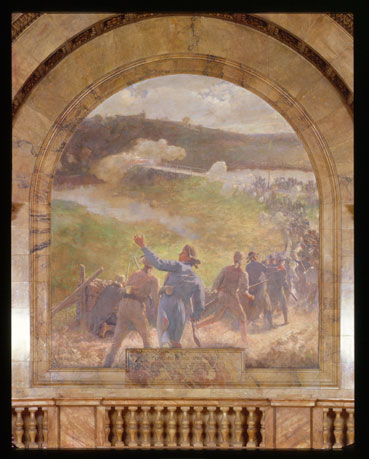
By Edward E. Simmons, 1902
Oil on canvas, 175 x 162 in.
Unveiled December 17, 1902.
Dispatched the previous night by General Gage to destroy munitions at Concord, the British regulars were preceded by Paul Revere and a host of other messengers calling the countryside to arms. With news of the horrifying bloodshed at Lexington earlier that morning, a band of minutemen marched to the edge of town to meet their adversaries, but shortly retreated, and the British occupied Concord without incident.
Three companies under Captain Walter Laurie guarded North Bridge while others searched the town for the stores of munitions. Meanwhile, approximately 450 minutemen and militia from Concord and neighboring towns had gathered on a small hill beyond town to monitor the troops. From their vantage point they could see smoke rising from the village.
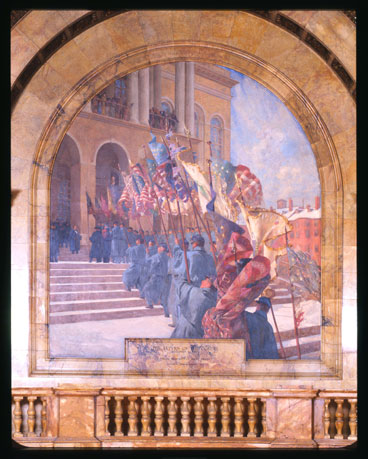
By Edward Simmons, 1902
Oil on canvas, 175 x 162 in.
Unveiled May 29, 1902.
By General Order No. 94 of the War Department, issued May 15, 1865, the colors of the volunteer regiments and batteries mustered out and discharged after the Civil War were to be transferred to their home states. On December 22, 1865, 166 national, state and presentation colors representing units of infantry, light battery, and heavy artillery were paraded up Beacon Street, passing by more than 2,000 veterans. On the steps of the State House they were presented to Governor John Andrew, the "War Governor," who had personally issued many of them to the units on their way to the south.
The importance of the flags to the troops and their safety cannot be exaggerated. Beyond symbolizing the union they fought to preserve, the flag served as a beacon in the chaos of battle, guiding them above the din and smoke back to their unit, and in countless cases, saving their lives. The flag also served as a marker for the enemy, however, pinpointing a unit’s position. Thus the color bearers, always in the front line, held one of the most dangerous jobs. It was also one of the proudest.
The emotional scene of the return of the battle flags, still vivid in many minds at the turn of the century, was a logical choice for the fourth mural in Memorial Hall. If Simmons' depiction was overly decorative, as some argued at the time of its unveiling, the artist, by subordinating all detail, captured the monumentality of the event. Red, white, and blue dominate the artist's palette. The diagonal line of soldiers and flags carries the eye up the stairs, past the governor, into the State House&8212;the flags' final resting place.
Originally installed in Doric Hall, they were moved to the large marble niches in Memorial Hall in January 1900. Over the years, the tattered and stained flags remained symbols of steadfast devotion and reminders of the heroic service and sacrifice of 140,000 dead and living sons of Massachusetts, as well as allegories of the fragility of life. They were kept on display for eighty-seven years until placed in archival storage in the State House, along with flags of other military engagements, where they continue to be monitored and preserved.
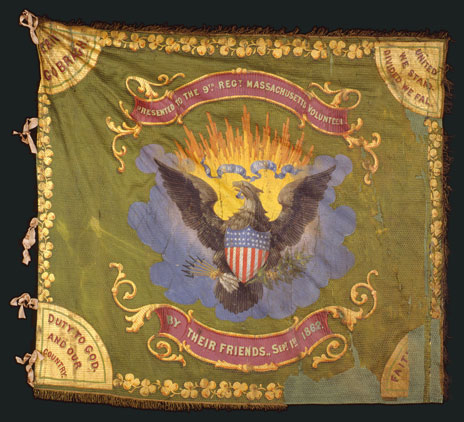
By Thomas C. Savory, 1862
Silk, pigment, 52 1/2 x 59 in.
Given to the unit by friends September 15, 1862.
Returned by the regiment to the Commonwealth December 22, 1865.
The pluralism and diversity of America is reflected in this banner in its slogans and symbols as well as in the men who carried it, many of whom had only recently arrived in this country and were ready to take up arms to defend their rights to their own religion, language, and ethnic heritage. The reverse of the flag, shown here, depicts the eagle and shield of the United States, and is decorated with shamrocks, all on a green field. The front portrays the harp of Ireland and the Irish wolfhound on a similar green field. Like other immigrants before and since, the Irish of Massachusetts gave concrete meaning to the motto in the Great Seal of the United States: "Out of Many, One."
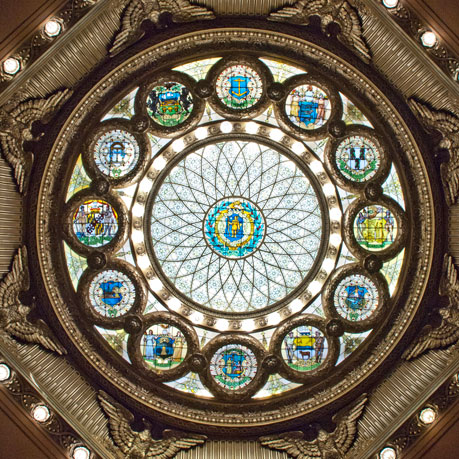
By Edwin Ford and Frederick Brooks, 1899
Stained glass, cast plaster, 50 ft. diam.
Commissioned by the Commonwealth, 1899.
Unveiled January 1, 1900.
Fifty-two feet above the floor of Memorial Hall is one of the many stained glass windows that can be seen throughout the Brigham extension. On a sunny day, this magnificent circular window bathes the room in soft colored light. Featured in the center is the nineteenth-century version of the seal of Massachusetts, surrounded by the seals of the twelve original states. Each seal is set in a plaster laurel wreath seventy-eight inches in diameter. Below, the ribbed cornice is supported by eight plaster eagles of the republic.
The contract for the ceiling light in Memorial Hall was awarded in August 1899 to the firm of Ford and Brooks, one of Boston’s leading stained glass studios at the time. The speed with which they fabricated and installed the large, intricate window by the time of the Hall’s dedication January 1, 1900, is indeed impressive.
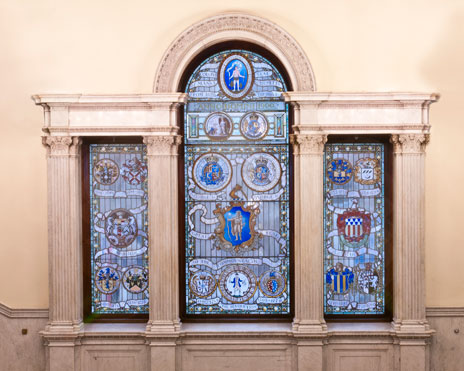
Designer unknown, 1900
Installed under Res. 1899, ch. 81.
The stained glass window on the landing of the Main Staircase is of a Palladian design, and contains the early seals of Massachusetts, as well as their mottoes, and those of her royal governors. At the top of the window is the earliest—the seal of the Colony of Massachusetts granted under the original charter of 1629—which shows a Native American standing between two pine trees. Below this are the seal of King James used under the despotic rule of Governor Edmund Andros (1686–1689); the seals of the Province of Massachusetts granted under the Second Charter (1692–1775); and the seal used from the ratification of the State Constitution in 1780 until 1898. At the bottom of this center panel is the "Magna Charta" seal used by the colony during the revolutionary period (1775–1780) showing an "English American" with a sword and a copy of the ancient document used by the English to limit the power of their kings. This is flanked by the seals of the governors Bernard and Hutchinson, whose terms led up to the time of the Revolution.
The left and right panels of this window contain the personal coats of arms of the provincial governors, beginning with Governor Phipps (1691, upper left) and ending with Pownall (1760, lower right).
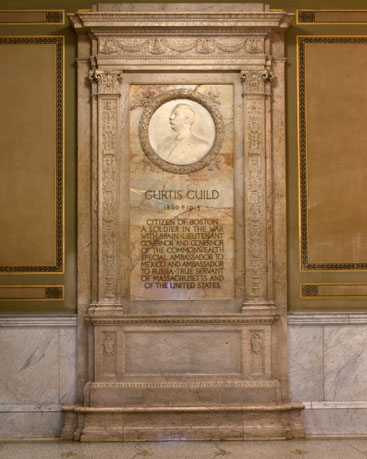
Designed by Cram and Ferguson, 1915
Frame by John Evans and Co., Boston
Portrait relief by Richard Recchia, 1915
Numidian marble and Istrian stone with bronze inlay, 84 x 40 x 12 in.
White marble, diam. 26 1/2 in.
Curtis Guild was honored with this Italian-Renaissance style memorial shortly after his death. The elaborate marble frame was carved by the John Evans Shop which would later fabricate the plaque commemorating John F. Kennedy's "City on the Hill" address. The memorial incorporates symbolic references to Guild's political and diplomatic career and contains a portrait relief by noted Boston sculptor Richard Recchia.
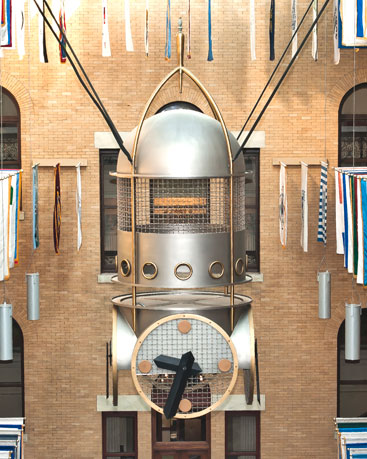
By Ronald M. Fischer, 1990
Glass, bead blasted stainless steel, bronze, 8 x 3 1/2 ft.
Commissioned by the Commonwealth under the "1% for Art" program authorized under G. L. 7, sec. 42C; amended G. L. 484, secs. 25, 26.
Installed July 17, 1990.
The competition for the Great Hall art project was issued in 1986. Carved out of the original nineteenth-century light-well, the new meeting hall, as a contemporary space, was to be designed "in concert with, rather than re-creating, the surrounding Italian Renaissance revival spaces" of the Brigham extension. Prospective artists were encouraged to consider not only design and function, but also "the distinctive historic, symbolic and artistic character" of the State House.
New York artist Ronald Fischer was selected from 480 applicants in 1988. Best known for his mixed-media, functional, or utilitarian sculptures, Fischer's clock references traditional silhouettes from New England architecture: clock towers, cupolas, and domes, but with non-traditional materials. "Bird-cage" netting on the sides lightens the load both physically and visually.
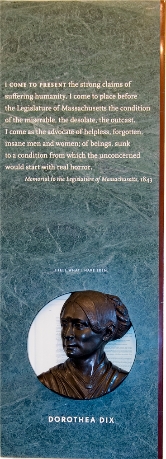
By Sheila Levrant de Bretteville and Susan Sellers, 1999
Marble, 67 x 23 in
Commissioned by the Massachusetts State Senate in conjunction with the Massachusetts Foundation of the Humanities
Dedicated October 1999.
DOROTHEA LYNDE DIX was born on the Maine frontier when it was still part of Massachusetts. After an unhappy childhood, she left home at the age of 12 to live with relatives in Boston and Worcester. Although she had little formal schooling, she spent her teens and 20s teaching and writing books for young readers. In the 1830s, Dix became seriously interested in how the outcasts of society— criminals, the poor, and, especially, the insane —were treated. Most people who suffered from mental illness lived in harsh conditions at home, in prisons, or in poorhouses. She began by visiting every city and town in Massachusetts. In 1843, her powerful firsthand report was published and submitted to the legislature, which was persuaded to increase funding for the overcrowded Worcester State Asylum. As her investigative and lobbying skills grew, she took her crusade to other states, where she played a direct role in founding 32 mental hospitals. After serving a few, troubled years as Superintendent of Women Nurses for the Union Army, she returned to her work as “the voice of the mad.”
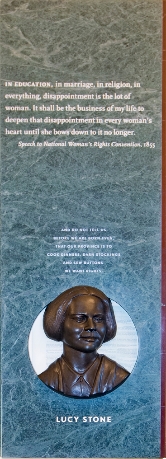
By Sheila Levrant de Bretteville and Susan Sellers, 1999
Marble, 67 x 23 in
Commissioned by the Massachusetts State Senate in conjunction with the Massachusetts Foundation of the Humanities
Dedicated October 1999.
LUCY STONE was one of the very first Massachusetts women to earn a college degree, graduating in 1847 from Oberlin College in Ohio. She embarked almost immediately on a career as a public speaker—during the week, she lectured against slavery, on the weekends, for woman’s rights. Over the next few years, she earned a good living, and a national reputation, giving public lectures on the injustices faced by blacks and women. When she married reformer Henry Blackwell in l855, Stone promised to love and honor her husband but refused to use the word “obey” or to take his name. After her marriage, Lucy Stone continued to lecture, drawing large and enthusiastic audiences. In 1857, she gave birth to her only child, Alice Stone Blackwell, and curtailed her lecturing. She was just returning to her career when the Civil War began. During the war, she worked for the Union cause; as victory neared, she supported ratification of the 14th and 15th Amendments, although she was bitterly disappointed that women were not given the vote along with black men. Stone’s allies Susan B. Anthony and Elizabeth Cady Stanton opposed ratification. The result was a bitter division in the woman suffrage movement, which lasted for more than 30 years. From her base in Boston, Lucy Stone founded the American Woman Suffrage Association, and, with the help of her husband and later her daughter, published the influential weekly paper the Woman’s Journal.”
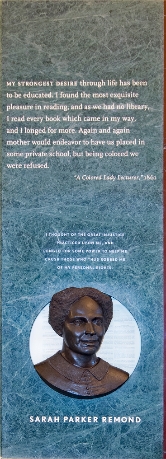
By Sheila Levrant de Bretteville and Susan Sellers, 1999
Marble, 67 x 23 in
Commissioned by the Massachusetts State Senate in conjunction with the Massachusetts Foundation of the Humanities
Dedicated October 1999.
SARAH PARKER REMOND was the granddaughter of a free black man who fought in the Revolutionary War. Her parents owned a successful business in Salem. They placed great value on education, but racially segregated schools kept Sarah from getting the formal schooling she desperately desired. The Remonds were ardent abolitionists. Sarah’s older brother Charles Lenox Remond was the American Anti-Slavery Society’s first black lecturer. In 1856, she joined him on the anti-slavery circuit and quickly became one of the Society’s most persuasive lecturers. Two years later, she was invited to take the anti-slavery campaign to Great Britain. She sailed alone in September 1858 and spent the next few years lecturing to enthusiastic crowds throughout England, Scotland and Ireland, and raising large sums of money for the cause. Once the Civil War began, she worked to build support in Britain for the Union. After the war, she stayed in England, soliciting funds and clothing for the newly freed slaves. She combined lecturing with courses at the Bedford College for Ladies. In 1866, she left England for Italy, and at the age of 42, entered medical school. She became a doctor, married an Italian, and, as far as we know, never returned to the United States.”
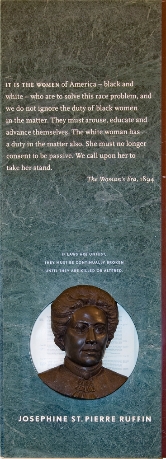
By Sheila Levrant de Bretteville and Susan Sellers, 1999
Marble, 67 x 23 in
Commissioned by the Massachusetts State Senate in conjunction with the Massachusetts Foundation of the Humanities
Dedicated October 1999.
JOSEPHINE ST. PIERRE RUFFIN was born in Boston. The city’s public schools were segregated, so her parents sent her to Salem, where the black community had succeeded in desegregating the schools. At the age of 16, having completed a Boston finishing school and two years of private tutoring in New York, she married George Lewis Ruffin, a barber who would later graduate from Harvard Law School, hold elected office, and become the first black judge in the North. The Ruffins helped recruit soldiers for the Mass. 54th and 55th regiments, and, after the Civil War, were active supporters of many causes. Widowed in l886, Josephine Ruffin started the Woman’s Era, the first paper published by and for African American women. The paper urged its readers to become actively involved in issues such as suffrage and racial injustice. In 1893 Ruffin founded the New Era Club, one of the first black women’s clubs in the country. Two years later she called the first national meeting of black women, which took place in Boston. That same year, she desegregated the Massachusetts State Federation of Women’s Clubs and was elected to its Executive Board. She was a charter member of the Boston chapter of the NAACP and a co-founder of the League of Women for Community Service, which still exists today”
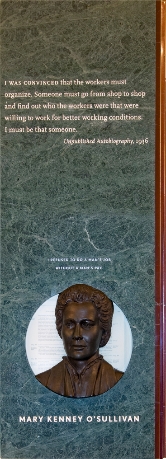
By Sheila Levrant de Bretteville and Susan Sellers, 1999
Marble, 67 x 23 in
Commissioned by the Massachusetts State Senate in conjunction with the Massachusetts Foundation of the Humanities
Dedicated October 1999.
MARY KENNEY O'SULLIVAN, the daughter of Irish immigrants in Hannibal, Missouri, got her first factory job at 14. Angry about the low wages and poor working conditions endured by women workers, she became a trade unionist. From 1892-93, she was employed as the first woman organizer for the American Federation of Labor, organizing garment workers, printers, binders, carpet weavers and shoe workers. While in Boston in 1892, she met John O’Sullivan, a former seaman who was labor editor of the Boston Globe. They were married in l894.With his help, she continued her career and remained active in the labor movement while raising three children. In 1902 she was widowed; a year later, she co-founded the National Women’s Trade Union League. As a leader of the WTUL, Mary O'Sullivan forged alliances between middle- and working class women. A leader in Massachusetts reform circles, she focused her efforts on woman suffrage, housing for the poor, prohibition, and pacifism. However, her highest priority remained the advancement of working women. Frustrated with the male-dominated labor movement, she turned to legislative remedies. She lobbied for laws to protect women and children in the workplace; when they were passed in 1913, she was hired as a factory inspector for the Massachusetts Department of Labor and Industries. She retired at age 70 in 1934.”
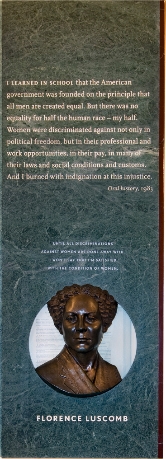
By Sheila Levrant de Bretteville and Susan Sellers, 1999
Marble, 67 x 23 in
Commissioned by the Massachusetts State Senate in conjunction with the Massachusetts Foundation of the Humanities
Dedicated October 1999.
FLORENCE LUSCOMB moved from Lowell to Boston at the age of two. She was raised by her mother Hannah, an active supporter of woman suffrage, trade unionism, and other progressive causes. Graduating from MIT in 1909, Florence Luscomb was one of the first women to receive a degree in architecture; she practiced until WW I brought a halt to most building. Her true calling proved to be political activism. She held paid positions with the Boston Equal Suffrage Association, the Massachusetts Civic League, and the Women’s International League for Peace and Freedom. She walked picket lines in support of striking workers and became an officer in the Boston local of the United Office and Professional Workers (CIO). She served on the boards of the Massachusetts Civil Liberties Union and the Boston branch of the National Association for the Advancement of Colored People. Florence Luscomb ran for public office four times. In 1922, she lost her race for Boston City Council by less than one percent. She ran for Congress in 1936 and 1950; in 1952 she was the Progressive Party candidate for Governor. Her platform advocated economic justice, peace, and an end to the widespread infringement of civil liberties which followed WWII. A lifelong radical, she was living in a Cambridge cooperative at the age of 90.”