
Virtual Tour
State House
Featured Areas
Points of Interest
- A. Governor
- B. House Majority
- C. State Library
- D. Secretary of State
- E. Senate Clerk
- F. Senate Majority
- G. Senate Minority
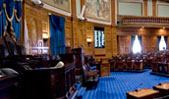
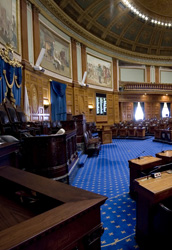
The House of Representatives has met in this room since 1895. Before the construction of the Brigham extension, the members occupied the chamber in the Bulfinch State House directly below the gold dome, now the Senate Chamber.
This two-story oval room measures eighty-six by sixty-eight feet. On the floor are seats for 160 representatives, arranged in a gently sloping semi-circle that faces the dais and the Speaker's rostrum. The chamber is paneled in white mahogany, and contains a curved gallery across the back wall for spectators and the press. This is where the ""Sacred Cod"" hangs, the historic pine carving of a New England codfish. Across the front of the room, facing the legislators, are five murals: Milestones on the Road to Freedom, painted in 1942, which illustrate key events in the furthering of civil liberties. Under the cornice are the names of fifty-three Massachusetts citizens honored for their lasting contributions to the political and cultural heritage of the Commonwealth.
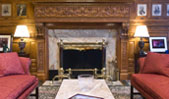
The Speaker's office is located within a suite of rooms connected to the House Chamber, designed by Charles Brigham and completed around 1895. As in all other major spaces of the extension, Brigham's cohesive design for the offices and reception rooms was reflected in his specifications for plaster and painted ornamentation, decorative wallpaper, paneling and built-ins. The richly patterned rooms, lit by new electric chandeliers, reflected the American Renaissance Revival focus on the integration of materials and fine craftsmanship. Of particular note are the classical motifs that appear in the raised plaster ceiling decorations and delicate carving of the dark mahogany throughout the suite. All rooms would have been completed with green, blue, ochre and gold to harmonize with the color schemes of the Brigham extension.

The Senate President's office is within a suite of rooms of the later nineteenth-century Brigham extension. From 1898 it served as the Senate Reading Room and library for members until it was adopted as the ceremonial office of the Senate President in 1970. Also within the suite are the president's small private office, the former Senate Clerk's office, and the Coolidge Room, a small office that was used by Calvin Coolidge during his term as president, and which has been preserved intact.
The President's Office was decorated according to the specifications of Charles Brigham in 1896; during the 1988 restoration, investigative paint analyses revealed stenciled patterns in olive and mustard colors in the ceiling cove. The ceiling is decorated with ornate plaster work, and the carved doors fitted with stained glass transoms. The lower half of the room is paneled and fitted with built-in cabinetry of white mahogany, all of which is finely carved. Egg-and-dart molding, broken scroll pediments, fluted pilasters, and wreaths and swags—all references to the neo-classical Bulfinch capitol—are teamed with floral and foliate decoration, creating richly patterned vistas throughout.
The A. H. Davenport Company supplied much of the woodwork and furniture for the suite. The carpet was installed in 1988 and is a reproduction of the original.
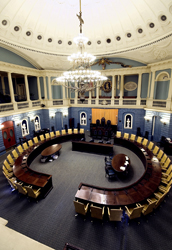
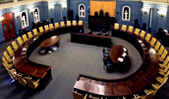
The current Senate Chamber, located directly beneath the gold dome in the Bulfinch portion of the State House, served as the Chamber of the House of Representatives for nearly one hundred years. Measuring only 55 feet square, it once held 635 members! Although this was remodeled several times during the mid-nineteenth century, most notably with ""block"" rustication on the lower level, the room retains much of Bulfinch's intricate plaster ceiling decoration with other original elements on the second floor. Upon completion of new chambers for the House in the 1890s Brigham extension, the Senate moved here from its former location across the hall, bringing with it the familiar circular desks for forty senators, and the President's rostrum. Galleries above allow for public viewings of the sessions. Around the perimeter niches contain marble busts of historic figures, and on the walls muskets from the Battle of Lexington, April 19, 1775, are displayed.
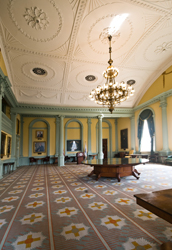
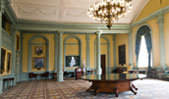
Formerly the Senate Chamber, the 200+ year-old Senate Reading Room remains one of the best-preserved Bulfinch spaces. Slender columns, delicate moldings and plaster work, and a gently vaulted ceiling characterize its late federal style. Now used for meetings, press conferences, and informal gatherings, this dramatic space features portraits of former Senate Presidents and examples of early nineteenth century furniture commissioned for the building.
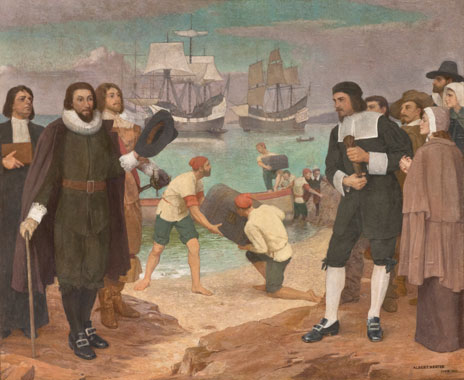
By Albert Herter, 1942
Oil on canvas, 110 x 130 in.
Gift of the artist and his son, Governor Christian Herter.
Unveiled December 16, 1942.
In 1630 John Winthrop sailed on the Arbella in a fleet of eleven ships with approximately 750 people, including shareholders of the Governor and Company of Massachusetts Bay in New England, who brought with them the original charter of Massachusetts secured from King Charles I in 1629. The charter granted governance over the land between the Charles and the Merrimack Rivers (land north of the Plymouth Bay Colony). Power was invested in a governor, a court of assistants, freemen who were the first stockholders, and later, larger landowners. Representatives of these groups constituted the first General Court.
John Winthrop is greeted in Salem by John Endecott who had arrived with other settlers five years earlier, and had served as governor until Winthrop's election.

By unknown artist, ca. 1784
Pine, painted, 10 x 59 1/2 in.
Given by John Rowe, March 17, 1784.
The Cod was given by John Rowe, a prominent merchant and representative from Boston, and installed in the Old State House "as a memorial of the importance of the cod fishery to the welfare of this Commonwealth, as had been usual formerly." This is the second carving of a New England codfish to preside over the General Court—its predecessor presumably lost during the Revolution. By this time, the image was a familiar one, appearing on everything from corporate seals to weathervanes and stairwell decorations. New claims to fishing rights both coastal and on the high seas, however, strained negotiations with England for years, and undoubtedly fueled Rowe's desire to reinstall the simple yet potent emblem over the heads of his fellow legislators.
When the new State House was inaugurated in 1798, there seemed to be no question whether the simple carving would follow the General Court to Beacon Hill. Installed in the House (current Senate) Chamber, it continued to symbolize the importance of the sea, and the fishing industry in particular, to the survival and prosperity of the Commonwealth. The Cod was transferred to the gallery of the current House Chamber in 1895, where it continues, "riding serenely the sound waves of debate, unperturbed by the ebb and flow of enactment and repeal…"
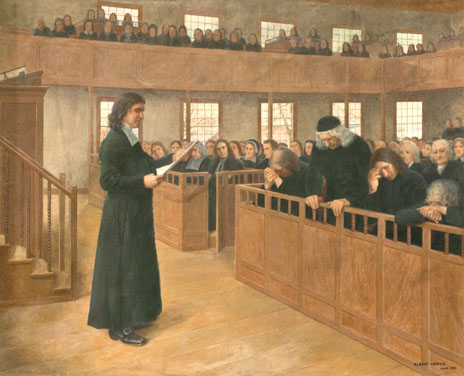
1697: The Dawn of Tolerance in Massachusetts: Public Repentance of Judge Samuel Sewall for his Action in the Witchcraft Trials
By Albert Herter, 1942
Oil on canvas, 110 x 130 in.
Gift of the artist and his son, Governor Christian Herter.
Unveiled December 16, 1942.
The widespread belief in witchcraft and the presence of the devil was swept into an outburst of confusion and accusation in 1692 when a small group of men and women of Salem (now Danvers) were arrested for bewitching their neighbors. Samuel Sewall (1652–1730), a local magistrate, was a member of the court that ultimately sentenced nineteen people to be hanged. The tragedy was realized several months later: those still being held were released, all judgments reversed, and records of excommunication expunged. At Sewall's urging, the General Court appointed a "Fast Day" during which all jury signed a confession of error in the convictions.
Sewall is seen standing in Old South Church in Boston with his head bowed as his confession and prayers for pardon are read aloud. Sewall is said to have fasted one day each year, praying for his soul and the souls of those wrongfully put to death. At the dedication of the murals, this event in particular was singled out as a turning point, for it represented "the beginning of the recognition of the 'quality of mercy' in human affairs."
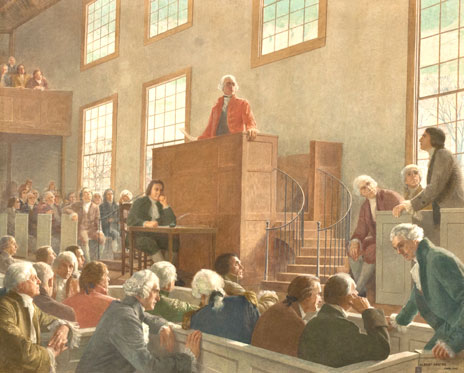
By Albert Herter, 1942
Oil on canvas, 110 x 130 in.
Gift of the artist and his son, Governor Christian Herter.
Unveiled December 16, 1942.
The Federal Constitution, which was modeled on that adopted by the Commonwealth in 1780, was drafted in Philadelphia in 1797 and required the approval of nine states for ratification. When taken up by the Massachusetts Convention in January 1788, many members opposed this version of the document as it lacked a Bill of Rights that would protect citizens from a strong central government. To meet the opposition, Governor John Hancock, who presided, proposed amendments that would guarantee certain privileges including freedom of speech, press, and religion, as well as the right to bear arms, regulated search and seizure, a speedy trial, and a trial by jury, among others. The Bill of Rights, which was probably drafted by Theophilus Parsons, was submitted to the assembly not as conditions for ratification, but as amendments to be considered by the first Congress. Upon ratification by Massachusetts in 1788, key states later also ratified the Constitution with the understanding that a Bill of Rights would be the first item of business considered by the new government.
This mural shows Hancock standing in the pulpit of the Meeting House on Long Lane (now Federal Street) in Boston proposing the Bill of Rights to the assembled group. In 1791, the first ten amendments – the Bill of Rights – which define and protect the rights of all Americans, were added to the Constitution.
By Albert Herter, 1942
Oil on canvas, 110 x 130 in.
Gift of the artist and his son, Governor Christian Herter.
Unveiled December 16, 1942.
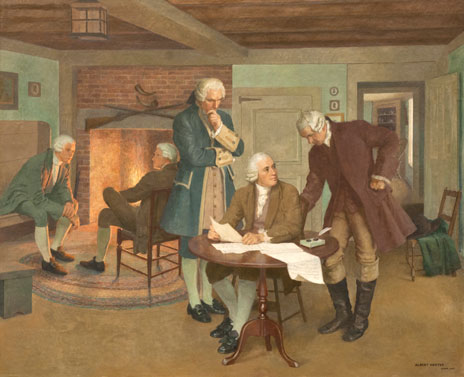
In 1775, the Massachusetts Provincial Congress removed General Sir Thomas Gage as governor and assumed administration of the colony under the second Charter of 1692. Fearful of the direction the state might take without a well-defined system of government, many demanded some form of compact—a constitution. The first draft of the document, prepared by the legislature in 1777 during the first Constitutional Convention, was overwhelmingly rejected.
A second convention held in 1779 appointed John Adams—lawyer, diplomat, author of Thoughts on Government (1776), and future president of the United States—and two colleagues to gather the myriad ideas into a fair, balanced, workable document. Concerns of representation in a bi-cameral legislature, separation of power among three branches of government, and the rights and consent of the governed fueled Adams' framework for a stable and democratic government, guided by a declaration of trust in public servants.
In this mural, Adams confers with Samuel Adams and James Bowdoin at his home in Braintree (now Quincy). The challenging nature of their work is expressed in the quiet concentration of the figures. The Massachusetts Constitution was ratified at town meetings in June 1780. One of the oldest working constitutions in the world, it served as the model for the constitution of the United States in 1788.
By Albert Herter, 1942
Oil on canvas, 110 x 130 in.
Gift of the artist and his son, Governor Christian Herter.
Unveiled December 16, 1942.
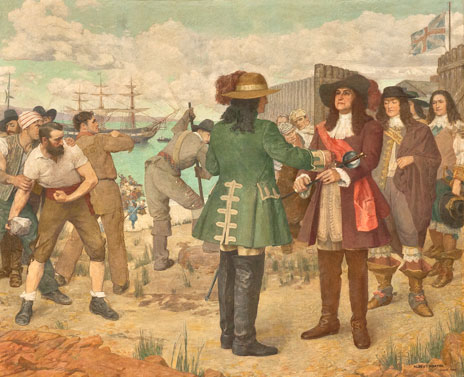
Dispute over the rights and privileges granted under the Charter of 1630 led to its revocation in 1684, leaving Massachusetts without any of its former land rights or the right to govern independently. The charters of other colonies were also annulled, and Sir Edmund Andros was appointed by the crown to govern over all. His despotic rule eliminated representative government.
In 1689, however, William of Orange led the successful overthrow of King James II. Word of this reached Boston which quickly took up arms. Fearing an uprising, Andros, who resided in town, retreated to Fort Hill where he was arrested without incident, and the "bloodless restoration" of the rights of Massachusetts citizens was achieved April 19, 1689. The Second Charter for the Province of Massachusetts Bay was issued in 1691.
By John Benson of the John Stevens Shop, Newport, RI
Monsoon slate, and 23 carat gold leaf, 21 x 40 in.
Installed January 25, 1972 under Res. 1969, ch. 2.
Unveiled by Senator Edward M. Kennedy, brother of the president.
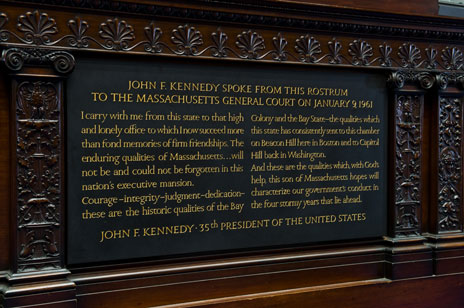
Ten days before his inauguration, John F. Kennedy delivered his "City Upon a Hill" address during which he quoted from John Winthrop's treatise, A Model for Christian Charity, invoking the attributes that Winthrop and his shipmates would need as they built a new government on a perilous frontier. Kennedy called on courage, judgment, integrity and dedication, qualities of the Bay Colony and the Bay State which he hoped would also characterize his administration.
The John Stevens Shop, founded in 1705, had received the commission for the lettering on the Kennedy Memorial at Arlington National Cemetery and was the natural choice for the Massachusetts project. As the speech was too long to replicate on the Speaker's rostrum, 111 words were carved into the same black slate used at the president's gravesite.
Photograph, 12 ½ x 11 ½ in.
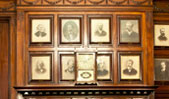
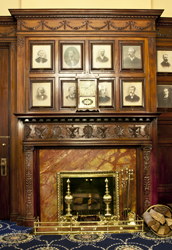
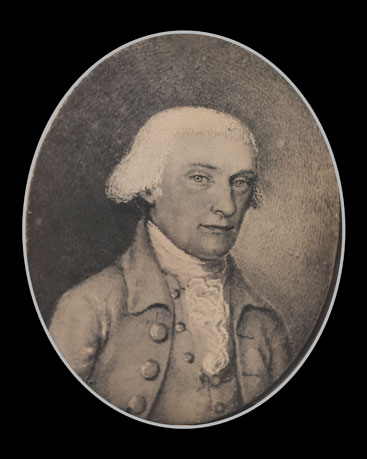
Circling the walls of the Speaker's Office are images of former Speakers dating back to the adoption of the Massachusetts Constitution in 1780. The earliest, Caleb Davis, a wealthy merchant and revolutionary war patriot, hangs on the wall opposite the fireplace, at the upper left. Prints and photographs are clockwise around the room—seventy-four at present.
The display was first installed in 1899 and is updated after each administration. Images of the earliest Speakers were reproduced from a variety of sources including extant paintings, prints, and line drawings until photographs could be obtained directly from each sitter. There is a similar display of former Senate Presidents in that office.
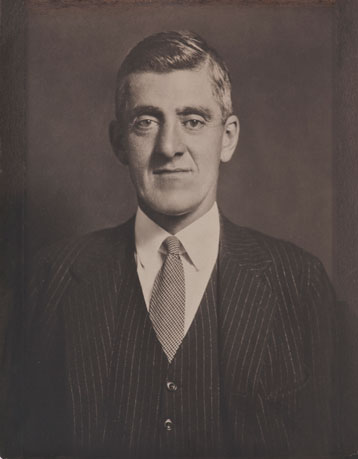
Photograph, 12 ½ x 11 ½ in.
Leverett Saltonstall, descendant of Sir Richard Saltonstall (who accompanied John Winthrop on the Arbella), graduated from Harvard in 1914 (LL.B in 1917), and served in the U. S. Army during WWI. He began his long and distinguished political career as an alderman in Newton, and served for a short time as Middlesex District Attorney before being elected to the House in 1922. "Salty," as he was popularly known, was chosen Speaker in 1929, serving eight years during the Great Depression.
In 1938 he defeated James Michael Curley for governor, who described him as having a "Harvard accent with a South Boston face." During his three terms, Saltonstall led the Commonwealth through World War II, tightening fiscal policy in support of the war effort while retiring over 90 percent of the state's debt.
Upon the resignation of Henry Cabot Lodge, Jr. in 1944, he was elected by a wide margin to the U. S. Senate, representing Massachusetts along with John F. Kennedy until the latter was elected president. Seen as a moderate by both parties, he was the ranking minority leader on five influential committees, and served as Republican whip. His political legacy remains in the thousands of pieces of legislation that he worked on to the benefit of the public he loved to represent.
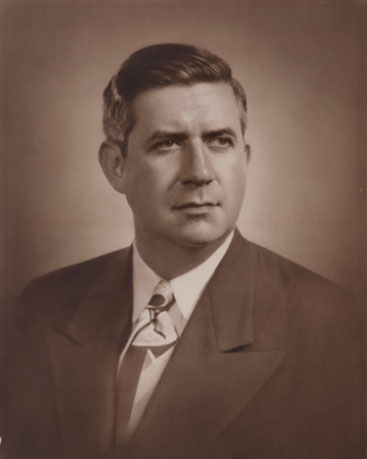
Photograph, 12 ½ x 11 ½ in.
"Tip" O'Neill graduated from Boston College in 1936 and immediately entered into politics. Elected to the Massachusetts House of Representatives the following year, in 1949 he became its first Democratic Speaker. In 1952 he was elected to the congressional seat vacated by Senator-elect John F. Kennedy. He served with long-time Massachusetts Congressman John W. McCormack (Speaker from 1962-1971), and Edward M. Kennedy who entered the Senate in 1962.
With powerful allies, O'Neill, an outspoken liberal Democrat, rose quickly through the ranks, gaining national attention with his early opposition to U. S. involvement in the Vietnam War and his support of the impeachment of President Richard Nixon. He sponsored the bill that created the Cape Cod National Seashore Park (1961), and as Speaker was instrumental in bringing the "Big Dig" to Boston. He served until his retirement in 1987—fifty years after he entered public service. In 1991 he received the Presidential Medal of Freedom. His wake was held in Memorial Hall.
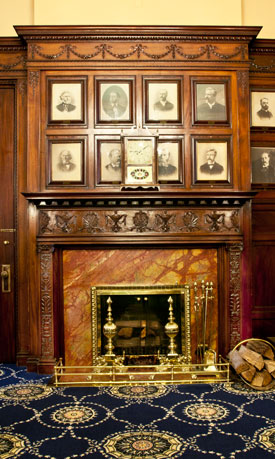
Mahogany, marble, brass, 64 x 81 x 9 1/2 in.
Possibly commissioned from A. H. Davenport Co., 1895
The Speaker's office features dark mahogany paneling accented by a carved frieze of swags and reeded egg-and-dart moldings. A handsome fireplace contains a red and ochre marble hearth and face, with carved pilasters and a frieze of classical urns and anthemion. Brass fittings and tools have been retained for this as well as a similar, equally majestic hearth in the adjacent office. Doorways in this room incorporate broken scroll pediments beneath intricately carved cornices.
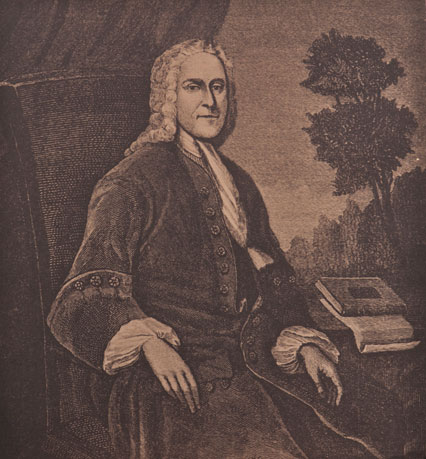
Photograph, 12 ½ x 11 ½ in.
Born into a prominent Boston family, Cushing graduated from Harvard in 1744, practiced law, and worked in his father's accounting firm where he became acquainted with the slightly older Samuel Adams. Elected to the General Court in 1761, he served as speaker during the tumultuous years leading up to the revolution, often being perceived by the British as the face of the colonial dispute. After dissolution of the assembly by Governor Gage in 1774 he was elected to the Massachusetts Provincial Congress, and served as a delegate to both the First and Second Continental Congresses.
The first General Court under the new Massachusetts Constitution convened at the Old State House on October 25, 1780, and Cushing was elected from the new state senators as their presiding officer. Among his duties during his one-week tenure, he delivered the oath of office to his life-long friend John Hancock as the first governor of the Commonwealth, under whom he served as Lt. Governor. He served briefly as Acting Governor during the months between Hancock's resignation and the administration of James Bowdoin, whom he served as Lt. Governor as well.
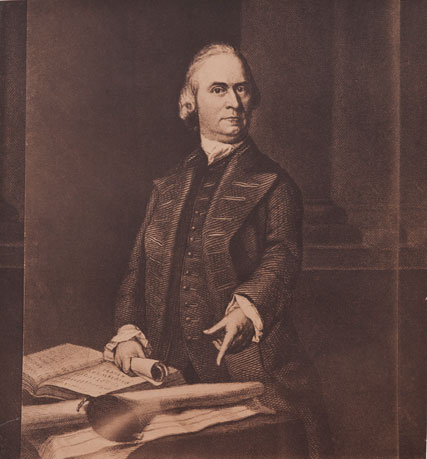
Photograph, 12 ½ x 11 ½ in.
Samuel Adams, colonial patriot and politician, while still at Harvard where he earned undergraduate and graduate degrees, already was demonstrating his tendency to question authority, especially in unjust circumstances. He worked for a short time with Thomas Cushing (later the first Senate President), and in the family malt house, but his business skills were found as lacking as his political interests were strong. He was elected to his first post in 1747, clerk of the Boston Market, thus beginning a long career in the political limelight.
Known best for his radical views on British sovereignty over the colonies, Adams was a popular figure whose notoriety spread quickly through his political appointments, fiery essays and his clandestine engagements. Although never a wealthy man like his colleagues John Hancock, Thomas Cushing and James Bowdoin, he rose to positions of power and influence in nearly every major political event until the end of his life. As Senate President he signed, with Governor Hancock, the Charter of the first Bank of Massachusetts in 1783, which included the first provisions requiring bank examinations. Taking a philosophical approach to the role of government, he promoted republican virtues and values, supporting public education and the federal constitution if amendments could be proposed.
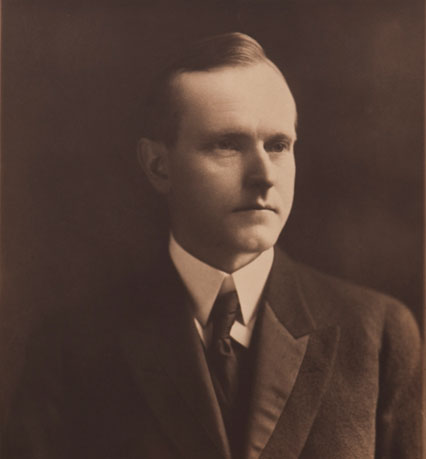
Photograph, 12 ½ x 11 ½ in.
After graduation from Amherst College, Coolidge began practicing law but soon was elected to a number of local seats, including Mayor of Northampton. In 1906 he won election to the House of Representatives, narrowly defeating the incumbent Democrat. Known as a Progressive Republican, he voted for women's suffrage and the direct election of Senators. In 1911, won a seat to the State Senate, and became chairman of the committee that arbitrated the "Bread and Roses" strike by the workers of the American Woolen Company in Lawrence. Reelected in 1913 by an increased margin, Coolidge was unanimously chosen President of the Senate. His acceptance speech was entitled Have Faith in Massachusetts. A small office within the Senate President’s suite, used by Coolidge during his term, has been preserved with original furnishings and wall finishes.
As governor, Coolidge supported wages and hours legislation, opposed child labor, favored safety measures in factories, and even worker representation on corporate boards. He gained national attention for settling the Boston police strike in 1919. Coolidge is the only Senate President to rise to the presidency of the United States. Making use of the new medium of radio, he was the first to have his inauguration broadcast, and on February 22, 1924, delivered the first presidential political speech from the White House. An impressive full-length portrait of Coolidge, painted by Edmund Tarbell, hangs in the Senate Reading Room.
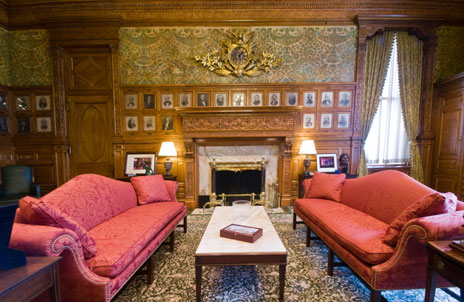
Fireplace: Probably commissioned from A. H. Davenport Co., 1898
Clock: Unknown maker, ca. 1900
Fireplace: Mahogany, marble, brass, 86 x 110 x 18 in.
Clock: Wood, gilded, 38 x 84 x 8 in.
Elegant fireplaces adorn each room of the Senate President's suite. That in the President's office is of white, ochre and green onyx marble with brass fittings and original andirons with flame finials. It is set into an elaborate mahogany mantle supplied by the A. H. Davenport Company, of Boston and New York, one of the largest and most prominent fine woodworking firms in the country.
Above the fireplace is a French-inspired, American-made electric clock installed around 1900. The gilded clock surround is decorated with symbols of strength and prosperity including oak leaves, cornucopia and eagle wings. Similar clocks can be seen in the major rooms of the Brigham extension.
The coffee table was commissioned in 1988 of materials that correspond to those surrounding the fireplace. Metal coffee urns that were converted to lamps flank the mantle.
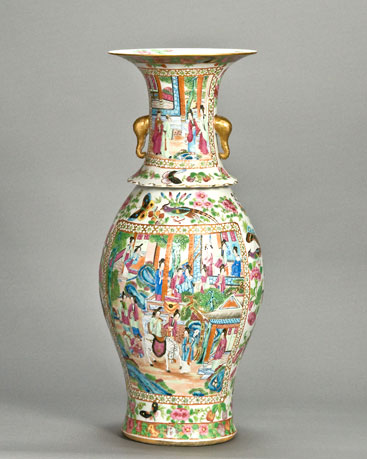
Chinese, by unknown maker, ca. 1840
Porcelain, painted and gilded, 23 x 10 in.
Given by Dorothy B. Hammond, in memory of Roland B. Hammond, North Andover.
The baluster-shaped vase has applied gilded "ears" and framed panels illustrating scenes from courtly life in garden and architectural settings. Surrounding these panels are flowers, birds, insects and other elements from nature depicted in famille rose, decorative patterns named for the predominantly pink and rose enamel colors found in Canton decorated porcelain that were favored in European markets.
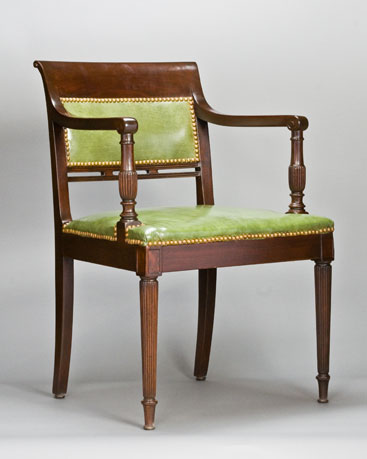
By A. H. Davenport Co., ca. 1898
Mahogany, 33 x 22 x 22 in.
This typifies the furniture commissioned for the Brigham extension from the A. H. Davenport Company. Dozens of these versatile mahogany chairs, which combined serviceable leather upholstery with elegant nail head accents and featured both scrolled and reeded arm supports, were purchased for the reception and committee rooms. Other examples include the small mahogany swivel desk chairs constructed with leather-paneled backs and nail head trim, and a suite of larger lounge chairs and settees, all upholstered in leather.
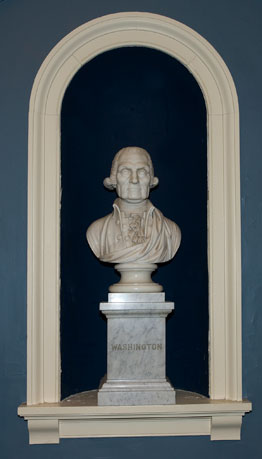
By unknown sculptor. Possibly modeled ca. 1800–1810 after an original plaster by Christian Gullagher at Christ Church, Boston
Marble, 24 x 20 x 11 in.
Presumed to be a purchase, ca. 1811. Resolves June 25, 1811.
The marble bust of George Washington is the first art object acquired for the new Bulfinch State House. A receipt in the Massachusetts State Archives, issued in 1811 from the Commonwealth to I. P. Davis for "a marble bust of Washington," is believed to reference this sculpture. (65 Roll Acct. no 1842). It was noted in Resolves of June 25, 1811 that the bust was intended for Representatives Hall.
First placed on display in the former House Chamber, the bust was installed in a staircase niche leading to the old "Green Room" (west of the Senate Chamber—above the executive offices), and then in one of the new niches that was constructed around the perimeter of Doric Hall in 1868. It remained there until 1898 when it was placed in the Senate Chamber.
Although acquired as a memorial to the President, the bust was for some time identified as a likeness of Samuel Adams until a small commission was appointed in 1890 to look into its authenticity. Research by the three-person panel led them to reaffirm the identification as that of Washington, based on its similarity to another bust of the president at Christ Church, Boston, which was modeled after a plaster bust by Christian Gullagher.
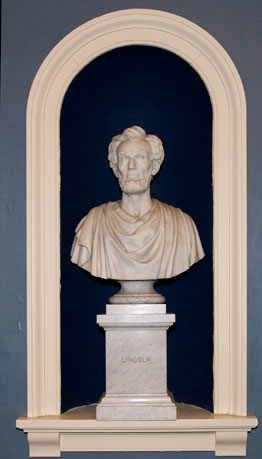
By Sarah Fisher Ames, 1867. Replica of original, most likely that in the United States Capitol
Marble, 30 1/2 x 24 x 15 in.
Purchased from the artist under Resolves 1867, ch. 88.
Lincoln's assassination in 1865 prompted countless memorial projects. In 1867 the Commonwealth authorized the acquisition of a bust of the late president from sculptor Sarah Fisher Ames, of Washington, D.C. Classically trained, Ames was a nurse and in charge of the hospital at the U. S. Capitol during the war. There she met the president on several occasions, and in 1862 modeled a portrait bust of him. This was originally installed in one of the niches that was created during the early remodeling of Doric Hall, and was later moved to the Senate Chamber.
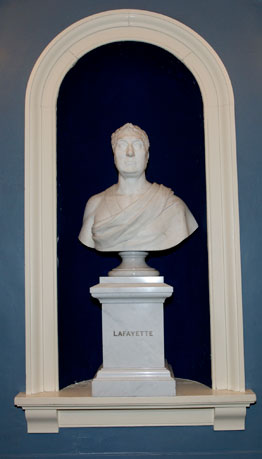
By Horatio Greenough, ca. 1831–1833
Marble, 26 x 24 x 12 in.
Gift of Horatio S. Greenough, son of the sculptor, January 26, 1898.
The best-known of the Frenchmen who fought against the British in the American Revolution, Lafayette, born an aristocrat, arrived in Philadelphia in 1777 at the age of nineteen with a commission as major general. At Brandeywine he served on Washington's staff, beginning a lifelong friendship with the future president. In 1779 he returned to France and persuaded King Louis XVI to send a 6,000 man expeditionary army to aid the colonists. His best showing was at Yorktown in 1781, when he forced the British commander Lord Cornwallis to retreat across Virginia. Returning to France in 1782 he was promoted to brigadier general.
On a much heralded tour of America in 1824, Lafayette, who was now the last surviving general of the Revolution, came to Boston. He was received in Doric Hall, and addressed the General Court from the original House Chamber. Less successful back in France in his later years, however, he was almost tried for treason after the monarchy was overthrown in 1830 for his efforts to suppress radical democrats.
Horatio Greenough, seeking a commission that would secure his place in the art world, imposed on his friend, author James Fenimore Cooper, in Paris, to obtain permission to model a bust of Lafayette. The general was much in demand, however, and Greenough waited several weeks for the first sittings. The result was several identical busts, carved upon his return to America, including the one at the State House. Toga-draped in the classical tradition, with a hint of the idealization, Greenough has communicated Lafayette's considerable height and physique through the thick neck and broad shoulders crossed by the military sword strap. Yet he has also captured furrowed brow and sagging jowls of the aged general, to reinforce the public's memory of the revered patriot. Similar versions of this bust are at the Museum of Fine Arts and the Pennsylvania Academy of the Fine Arts.
Since 1935 the twentieth day of May is celebrated as Lafayette Memorial Day in Massachusetts. In recognition of his lasting contribution to Franco-American friendship and cooperation, a plaque was installed in Doric Hall in 1992.
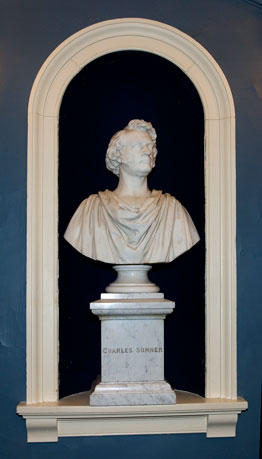
By Martin Milmore, 1869
Marble, 30 x 28 x 16 in.
Gift of A. A. Lawrence and others, April 27, 1869.
Sumner, the outspoken senior senator from Massachusetts, was aligned with both President Lincoln and Governor Andrew during the war on issues of slavery and emancipation, delivering landmark speeches that brought him into conflict with political and citizens alike. In recognition of his long and distinguished representation of the Commonwealth, he is honored at the State House with a painting by Henry Ulke and this bust by Milmore. One of three busts by the sculptor in the collection, this is all the more remarkable since Milmore was only twenty when he modeled this.
The bust probably was installed in Doric Hall in one of the niches created during mid-nineteenth century renovations (since removed), until it was relocated in the Chamber upon the Senate's occupancy in 1898. Another version of this bust is in the collection of the U. S. Senate, dated 1875.
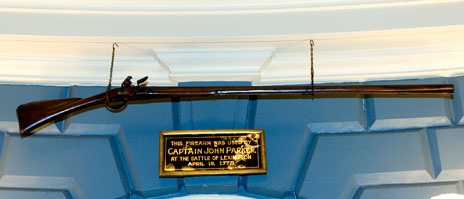
American, light fowler, mid-18th century
Walnut (?), iron, later brass plates
Overall length: 59 3/4 in., barrel length: 44 in., length to trigger pull: 46 1/2 in., .62 caliber
Bequeathed by Rev. Theodore Parker, grandson of John Parker, 1861.
The trigger guard is of Dutch form but is probably American-made. The butt-plate tang is of the stepped design favored in British military and hunting guns.
Despite service during the French and Indian War, Parker, a farmer and mechanic in rural Lexington, would most likely not have owned a traditional military firearm, but rather one more suitable for hunting such as this fowling piece. It is not known if Parker, as the captain of the Lexington Minutemen, actually fired this weapon on that historic morning, but his musket is one of the rare documented artifacts of the day.
Parker died less than six months after the Battle at Lexington, his firearm and other personal effects descending to his children. Despite its uniqueness among extant artifacts, firearms were expensive and continued to be used long after the Revolution, evidenced by extensive burn-back, as well as modernization or replacement of many parts, probably during the 1820s.
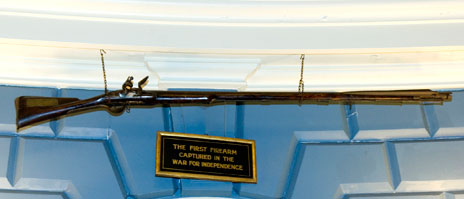
British, Longland pattern musket, 1756 (Grice lock dated 1762)
Walnut, iron, steel, later brass plates
Overall length: 62 in., barrel length 45 15/16 in., .765 caliber
Bequeathed by Rev. Theodore Parker, grandson of John Parker, 1861.
The 43rd Regiment of Foot was one of the units that marched from Boston through Lexington to Concord on April 19, 1775. The 43rd suffered both captures and casualties that morning, particularly on the retreat from Concord, and this musket was likely retrieved from one of those soldiers. It bears internal assembly marks, crown property and proof marks, company and rack numbers that place it with this light infantry unit. It was given to Captain Parker in recognition of his leadership at the historic standoff at Lexington earlier that day, during which the colonies suffered the first casualties of the War for Independence.
On January 26, 1861 both Parker muskets were accepted for the Commonwealth by Governor John A. Andrew and via joint convention were transferred to the Senate, where they have hung together in the Senate ever since.
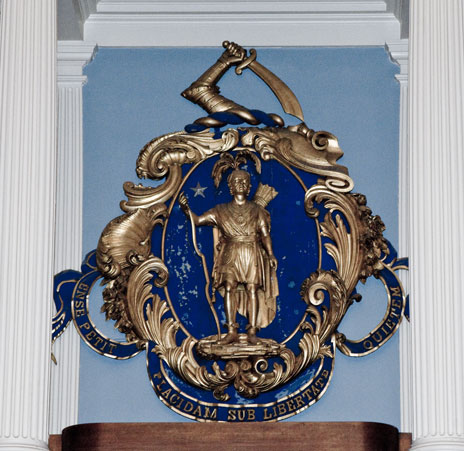
By unknown artist, 1847
Painted and gilt wood
Commissioned under Res. February 24, 1847.
In the gallery, over the President's rostrum, is a large carving of the 19th century version of the coat of arms of the Commonwealth adopted in 1780. The heraldry can be traced back as far as 1639 when Massachusetts settlers adopted a seal that depicted a Native American with an unstrung bow and a down-pointed arrow. The background is painted blue, while the figure, shield and sword arm are gilded. The sword is a copy of one belonging to Miles Standish.
The design, originally engraved by Paul Revere, was further refined in 1898. Variations appeared until the official seal of the Commonwealth was standardized in 1908; this now includes the motto Ense petit placidam sub libertate quietem (By the sword we seek peace, but peace only under liberty).
Recent investigative analysis reveals that despite several layers of restoration and reinforcement, the coat-of-arms appears essentially as it did when it was fabricated at a cost of $375.25 for the original House Chamber over 160 years ago.
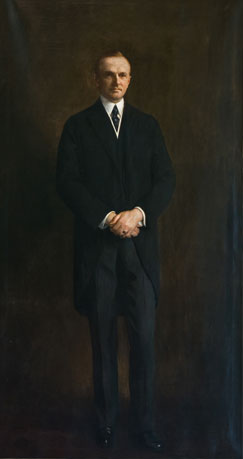
By Edmund Charles Tarbell, 1925
Oil on canvas, 100 x 47 in.
Commissioned by the Commonwealth under General Laws, ch. 8, sec. 19A.
Accepted under Res. 1925, ch. 2. Unveiled May 20, 1926.
By the time he received this commission, Tarbell was a leading member of the Boston School of artists, specializing in portraits and impressionist landscapes and interiors. He painted the portrait of President Coolidge in Swampscott, and in his New Hampshire studio during the summer of 1925. This remains one of the treasures of the Collection: an elegant full-length portrait from life of the sitting president executed in Tarbell's mature style, with great subtly in the handling of many shades of black and white.
Although commissioned by the Commonwealth to mark his term as governor, the portrait was installed in the Senate to honor Coolidge as the only Senate President of Massachusetts to rise to the presidency of the United States.
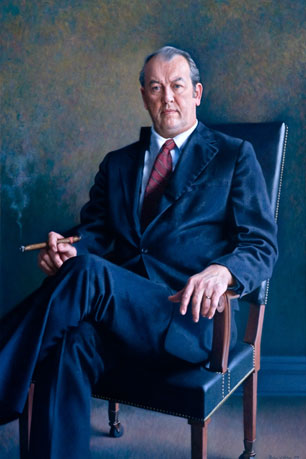
By Richard Wheeler Whitney, 1979
Oil on canvas, 60 x 40 in.
Gift of friends of Kevin Harrington, May 11, 1979
Richard Whitney received the commission for this portrait through Vose Galleries of Boston, and painted it at Mr. Harrington's home in Salem over the course of three months. Whitney recalled that the commission was for a three-quarter length portrait, and he was greatly concerned over how to paint the 6 ft. 6 in. Harrington, and thus chose a seated pose. A chair from the Senate was brought to Salem for which Harrington was undoubtedly grateful, since the sittings often lasted as long as six hours each. "He's tough," Whitney remembered, "but he has a sense of humor. So he sat in an authoritative manner, but the cigar added to the casualness he also possessed. He told jokes all the time, so he's painted with a crack of a smile, hinting at the humor beneath. I think he was an easy man to capture…he was just delightful. We talked politics all the time and he was just fascinating."
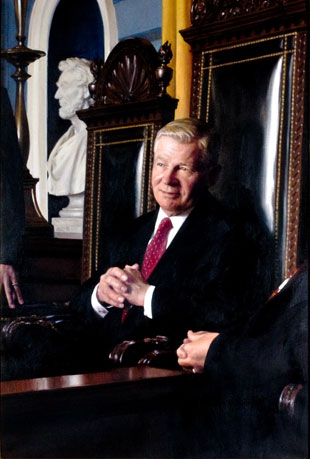
By Warren and Lucia Prosperi, 2007
Oil on canvas, 45 1/2 x 30 in.
Presumed to be a gift of the sitter.
Commissioned from Boston artists Warren and Lucia Prosperi, this portrait depicts Bolger seated at the rostrum of the Senate Chamber. The realistic style, based closely on photographs of the sitter taken in situ, captures the Senate President in an attentive, yet contemplative pose. Although he sits in a tightly compressed space, amid many pieces of furniture, room features, and even unseen companions, the artists' strong, even handling of all elements prevents them from overwhelming the portrait.
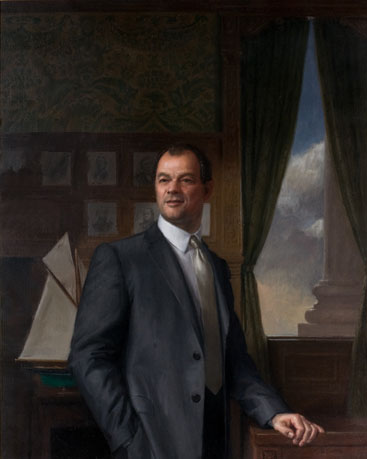
By Tomas Ouellette, 2008
Oil on canvas, 50 x 40 in.
Gift of Robert E. Travaglini, June 25, 2008.
Travaglini ran for the Senate in 1992, and within the decade was guiding the upper house as president through a period of great fiscal instability, as well as leading reforms in healthcare and human services.
After three years Travaglini passed the gavel to his colleague Therese Murray, and commissioned a portrait from Boston artist Thomas Ouellette to mark his tenure. Although a self-described contemporary realist, Ouellette followed Travaglini's request and depicted him in the office of the Senate President (constructed in the eighteenth century), with images of his predecessors placed on the wall behind him. For inspiration, the artist looked to Gilbert Stuart, the leading portrait artist of the federal period, and adopted the low horizon line, exterior column, and dramatic sky often seen in Stuart's political portraits. Even the pattern created by the parted drapes, reflected most obviously in the sails of the boat, can be seen throughout the composition.
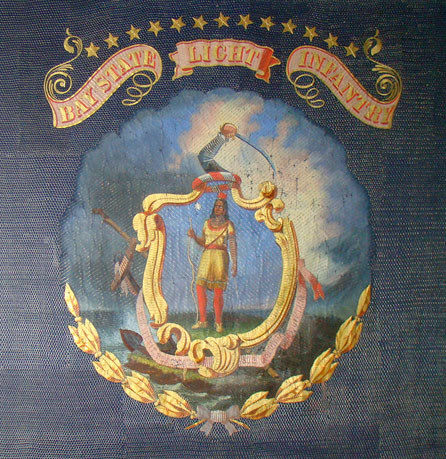
By unknown fabricator, 1852
Silk, blue, 48 x 66 in., painted on each side with state coat-of-arms and 13 gold stars
Given to Governor Calvin Coolidge through James Beatty, Sergeant-at-Arms, by Rep. Frank Barrows in behalf of Hannah Bartlett Griffith Shaw, Carver, Mass, December 20, 1920.
Company K of Carver, Mass., was raised by Thomas B. Griffith and others under Special Order No, 21, June 1852, and incorporated into the 3rd Regiment, 2nd Brigade, 1st Division. The regiment was selected to help fill the state's quota of the first call of President Lincoln for troops to defend the U. S. Capitol in April 1861, after which it was eventually depleted in order to fill other calls for volunteers. Griffith, a prominent Carver businessman, remained associated with the unit until the late 1860s and likely was given the old banner in thanks for his service. It was installed in the Senate Reception Room in 1921.
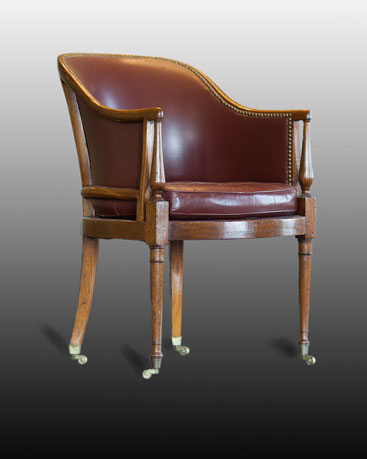
By George Bright , ca. 1797
Mahogany, ash, leather, 32 x 24 x 21 1/2 in.
Purchased for the new State House, 1797.
Boston cabinetmaker George Bright (1726–1805) made thirty of these barrel-backed chairs for the "Agents for building the new State House." The bergere form had been popular in Europe since the early eighteenth century. It is characterized by a continuous upholstered back and closed sides, and usually has a loose cushion on its deeper-than-usual seat. The State House examples end in fluted arm supports. Only one remains here, and is among the earliest documented pieces of furniture in the collection. The other chairs were dispersed among members of the legislature during the mid-nineteenth century—most are now in museums, including the Bostonian Society, Historic New England, and Winterthur. A reproduction stands nearby.
Another, larger set of mahogany bergeres, covered in black horsehair, dates to the early nineteenth century. These have the characteristic fluid back and sides, but feature taller frames with splayed crest rails and scroll arms that date to the later Empire and Directoire styles.
Among the many other examples of New England furniture in the room is a set of twentieth century Jacobean Revival high-backed arm chairs with black upholstery. The style is easily identified by its tall sloped back, long slender arms, and carved legs and stretchers that recall the handcrafted character of early seventeenth century English furniture. Three variations of this chair are among the nine on view. Five bear the name of their former occupants, including William Saltonstall and Kevin Harrington.